Hydropower, Challenges and Opportunities

Hydropower is a renewable source of energy (IEA, 2023). Hydroelectricity is generated by harnessing the movement of water from higher to lower elevations to generate electricity through turbines and generators in hydroelectric power plants (IPCC, 2010). By converting the kinetic energy of flowing water into electrical energy, hydropower contributes significantly to the global renewable energy mix (IRENA, 2019) and plays a critical role in advancing opportunities toward achieving net-zero emissions targets (IHA, 2025).
Resilience of Hydropower Sector
The resilience of the hydropower sector is closely tied to climate variability, precipitation patterns and the ability of hydropower infrastructure to adapt to climate-driven changes, which is essential for supporting the global transition from fossil fuels to renewable energy sources (IHA, 2025).
Size and Type
Hydropower projects are commonly classified by their installed capacity and, in some cases, by reservoir size or dam height. Small hydropower typically refers to projects up to 10 MW, often run-of-river schemes with minimal storage, suitable for local or rural electrification (IHA, 2021).
Medium-sized projects range from 10–100 MW, serving regional grids with moderate storage, while large hydropower exceeds 100 MW, often involving substantial reservoirs, extensive infrastructure, and significant ecological and social impacts (World Bank, 2019). Mega projects, above 1,000 MW, are associated with major river basins and large-scale resettlement. Additionally, the International Commission on Large Dams (ICOLD) defines a large dam as one over 15 meters in height or with a reservoir volume greater than 3 million cubic meters, highlighting that both capacity and physical dimensions are considered in sizing hydropower projects (ICOLD, 2020). In India, hydropower projects are categorised based on their installed capacity, with different classifications for small to large-scale projects (Government of India, Ministry of Power, 2022).
Hydroelectric power plants are typically classified based on their operational features and the type of flow they utilise (Hydropower Europe, 2020). These include installations equipped with a reservoir, which store water for later use to ensure consistent generation even during dry periods; storage power plants, which store large amounts of water in reservoirs and release it gradually to generate electricity as required and pumped-storage power plants, which use two reservoirs, one at a higher elevation and another at a lower level, pumping water upward during low energy demand and releasing it back to generate power during peak demand. Run-of-river power plants divert river flows directly to generate electricity without significant storage, thus making them less affected by seasonal fluctuations (Hydropower Europe, 2020). Hydropower projects are also classified by capacity: micro hydropower projects have an installed capacity of up to 100 kW, mini hydropower projects range from 101 kW to 2 MW, small hydropower projects have capacities between 2 MW and 25 MW and mega hydropower projects are large-scale installations with a capacity of 500 MW or 2022).
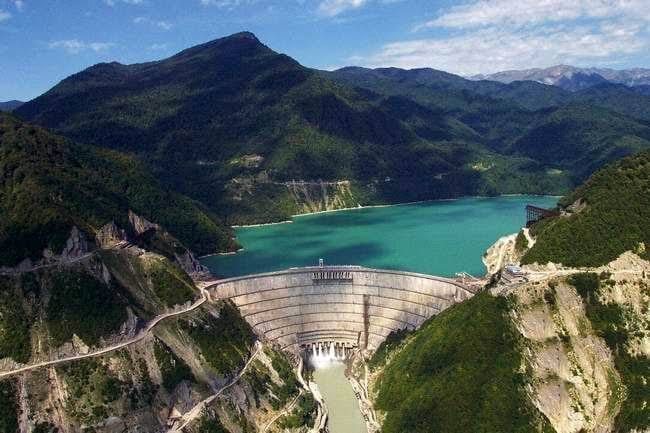
Hydropower plants can also be categorised according to dam structure and engineering design, which determine how water is stored, controlled, and converted into electricity. These include gravity dams, arch dams, buttress dams, embankment dams, diversion weirs, and underground or barrage-based projects, each suited to a specific topographical and geological setting (IPCC, 2010). A gravity dam relies on its own weight to resist the horizontal thrust of water and is typically made of concrete and is stable in narrow valleys with firm bedrock (Central Water Commission, 2020). An arch dam, curved upstream, transfers the water load to the valley sides, making it ideal for steep, rocky gorges. Examples include India’s Idukki Dam (Central Electricity Authority, 2018). Buttress dams are reinforced by a series of supports on the downstream side, allowing thinner walls and reduced concrete use while maintaining stability (CWC, 2020). The embankment dam is the most common type of dam globally and uses compacted earth or rockfill. the Tehri Dam in Uttarakhand is India’s largest example, combining earth and rockfill design for flexibility and seismic resilience (Tehri Hydro Development Commission India Ltd., 2023).
In contrast, diversion or run-of-river schemes employ low weirs or barrages to redirect part of a river’s flow through turbines, generating power with minimal storage (South Asia Network for Dams, Rivers and People,2024). These are prominent in Himalayan regions where sediment load and ecological sensitivity and Renewable Energy, 2024). Underground hydropower plants utilize natural elevation differences and tunnels, reducing surface disturbance and visual impact, as seen in Tehri’s underground powerhouse complex 3 / 14(CEA, 2022). Together, these structural types reflect how hydro power adapts to terrain and hydrology: from massive storage dams on stable plateaus to flexible embankment and diversion systems in fragile mountain landscapes.
The above paragraphs outlined the different types and sizes of hydropower projects, raising an important question i.e. why is it relevant to discuss the size and variety of hydropower systems? It is important to briefly touch upon size and types of hydropower projects this review since the size and type of hydropower greatly determine the impacts the power plant may have on the environments and landscapes they are built in. different types and sizes of hydropower yield different results on social and environmental landscapes of the river basins they are constructed on for example a small micro power plant without a reservoir will cause no submergence of land or displacement of people whereas a medium to large sized embankment or gravity or rock fill dam specifically either a reservoir, will lead to submergence and inundation of large swathes of land and cause social displacement for large communities who resided in the region that will be submerged due to the commissioning of such a project.